Introducing Vitesse: Vite for ExpressionEngine

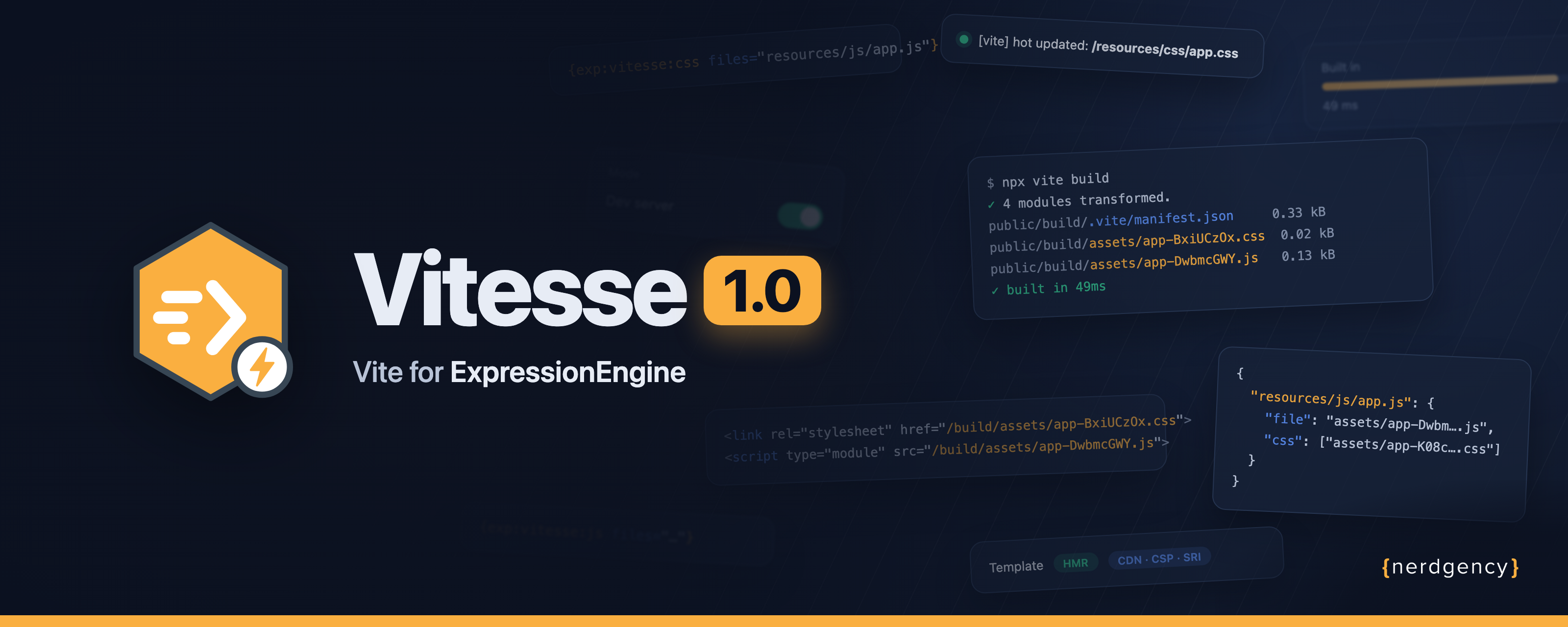
Vite has become the way front ends are built: an instant dev server, changes on screen as you save, and a fast, tidy production build. Using it with ExpressionEngine has meant writing the glue yourself: working out which hashed file to load, remembering the CSS your scripts import, switching between the dev server and the build.
Vitesse is that glue, done properly, and it's free. Tell a template which entry points it needs, and Vitesse prints the right tags, whether Vite's dev server is running or you've just built for production.
- Hot module replacement while you work: save a stylesheet and the page updates.
- Hashed, preloaded files when you publish, read from Vite's manifest.
- The same template for both, with no switch to flip.
- Stylesheets in the head, scripts in the footer, each file once.
- Ready for production: CDN base URLs, CSP nonces and subresource integrity.
One template, two modes
<head>
  {exp:vitesse:css files="resources/js/app.js"}
</head>
<body>
  {layout:contents}
  {exp:vitesse:js files="resources/js/app.js"}
</body>
While npx vite runs, that loads your source files from the dev server, with Vite's client for live updates. After npx vite build, it loads the hashed files from your build. Vitesse knows which by a small hot file your Vite config writes while the dev server runs. The setup guide has a complete vite.config.js, and if you use laravel-vite-plugin, Vitesse reads the hot file it already writes.
The details that usually bite
Vite's manifest is simple until it isn't. Vitesse handles the parts that are easy to get wrong:
CSS your scripts import
import './app.css' becomes its own file in a build. Vitesse includes it, and the CSS of every chunk your script imports.
Preloads
Shared chunks get a modulepreload, so the browser fetches them in parallel.
Any entry type
TypeScript, JSX, Vue, Sass, Less: each gets the right tag, in development and in the build.
Every Vite since 3
Vite 5's .vite/manifest.json and the older manifest.json are both found, from your web root.
Each file once
Partials can ask for what they need. Nothing is printed twice on a page.
Problems explained
A missing manifest or a mistyped entry is explained in the template debugger, not left as a broken tag.
Images and fonts
For a file your template uses directly, {exp:vitesse:url} gives its URL, from the dev server or the build:
<img src="{exp:vitesse:url src="resources/images/logo.svg"}" alt="Acme">
Ready for production
Set things once in config.php, or per tag:
- A CDN:
vitesse_base_urlserves built files from another host. - A Content Security Policy:
nonce=puts your nonce on every tag Vitesse prints. - Subresource integrity: when your build adds hashes to the manifest, Vitesse prints them.
See Production and Configuration.
Get started
Vitesse needs ExpressionEngine 7 or later, PHP 8.1 or later, and Vite 3 or later. Download it free from the ExpressionEngine add-on store.
Download it free, copy one folder, and Install.
Set up ViteA vite.config.js that works with Vitesse.
Template tags:assets, :css, :js and :url.
ProductionCDN, CSP and integrity.
Vite made front-end development fast. Vitesse makes it fast in ExpressionEngine, too.